With a bio-cleaner you always get excellent cleaning results

From Vestelli you get proven effective wastewater systems. Long-lasting and worry-free Finnish Vestelli treatment solutions are an environmental act.
The bio purifier has been independently tested for six years. The bio purifier meets the strictest requirements of the Wastewater Act 19/2017 under all conditions. With the bio purifier, you will always get excellent cleaning results regardless of the equipment level of your property, varying usage and seasons – and nature will thank you.
The bio-purifier is suitable as a wastewater solution even for sites with the strictest requirements and has been approved in all Finnish municipalities.
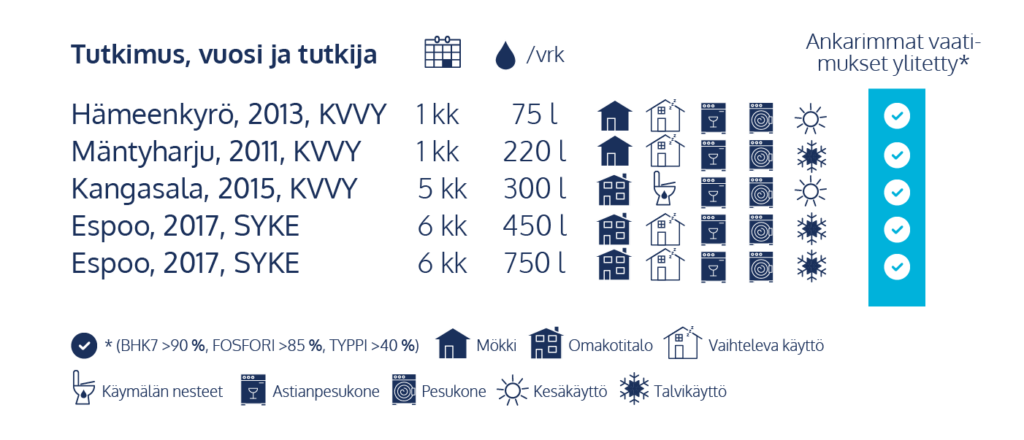
The biopurifier has been studied in various locations (detached house and cottage use), under different conditions (summer, winter and intermittent use), and under different loads (75 l/day, 220 l/day, 300 l/day, 450 l/day and 750 l/day) between 2011 and 2017.
All tests have been conducted impartially (KVVY or SYKE) and in each test the Biopurifier’s cleaning results fully meet the stricter requirements of the Wastewater Decree (157/2017): BOD7 < 45 mg/l (at least 90%), phosphorus < 3 mg/l (at least 85%) and nitrogen < 76 mg/l (at least 40%). Intermittent use does not affect the Biopurifier's operation. The Biopurifier's cleaning results always exceed the strictest requirements under all conditions.
Below are the results in summary, the full research results can be found on the designers page.
Study 1: Mäntyharju, 2011, test period length 1 month (winter)
Systems: Bio-purifier for grey water and closed tank for toilet water.
Summary: The water use of the year-round cottage consisted of grey wastewater (dishwashing, laundry, shower and kitchen water) and separate toilet wastewater. Estimated water consumption 220 l/day. Usage was variable during the study. There were no changes in the system’s cleaning level despite irregular use.
| Mäntyharju, 2011, test period length 1 month (winter) – KVVY | |||
| CLEANING POWER | BHK7 | PHOSPHORUS | NITROGEN |
| Bio-purifier | 99% | 97% | 99% |
| STANDARD | BHK7 | PHOSPHORUS | NITROGEN |
| Basic cleaning requirement | 80% | 70% | 30% |
| Stricter cleaning requirements | 90% | 85% | 40% |
Study 2: Hämeenkyrö, 2013, test period length 1 month (summer)
Systems: Bio-purifier for grey water and closed tank for toilet water.
Summary: The water use of the year-round cottage consisted of grey wastewater (dishwashing, laundry, shower and kitchen water) and separate toilet wastewater. Estimated water consumption 75 l/day. During the study, usage was variable. There were no changes in the system’s cleaning level despite irregular use.
| Hämeenkyrö, 2013, test period length 1 month (summer) – KVVY | |||
| CLEANING POWER | BHK7 | PHOSPHORUS | NITROGEN |
| Bio-purifier | 99% | 97% | 97% |
| STANDARD | BHK7 | PHOSPHORUS | NITROGEN |
| Basic cleaning requirement | 80% | 70% | 30% |
| Stricter cleaning requirements | 90% | 85% | 40% |
Study 3: Kangasala, 2015, test period length 5 months (summer)
Systems: Bio-purifier for grey water and large-tank dry toilet (leaching liquids drained into grey water).
Summary: The water use of the detached house consisted of grey wastewater (dishwashing, laundry, shower and kitchen water) and possible leachate from the large-tank dry toilet. Estimated water consumption 300 l/day. The use during the study was regular use of the detached house. The system operation was extremely stable during the observation period.
| Kangasala, 2015, test period length 5 months (summer) – KVVY | |||
| CLEANING POWER | BHK7 | PHOSPHORUS | NITROGEN |
| Bio-purifier | 99% | 89% | 97% |
| STANDARD | BHK7 | PHOSPHORUS | NITROGEN |
| Basic cleaning requirement | 80% | 70% | 30% |
| Stricter cleaning requirements | 90% | 85% | 40% |
Study 4: Espoo – Finnish Environment Institute, Suomenoja Research Station, 2017, test period length 6 months
Systems: Bio-purifier for grey water.
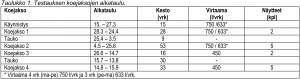
Summary: The biopurifier was tested for a total of six months. Water consumption varied between 750 l/day and 450 l/day during the different test periods of the study. The testing was divided into the test periods presented in Table 1:
Wastewater is pumped to the Suomenoja research station from a nearby residential area, which consists of approximately 40 residential buildings. This wastewater includes all wastewater generated in the residential area and does not contain industrial wastewater or similar. Occasional meltwater is possible.
For testing, this wastewater was treated to match grey wastewater as closely as possible. The incoming wastewater was pumped into a storage tank (15 m3) with a mixer, from which the water used in the testing was taken after partial clarification.
The incoming wastewater was diluted with clean network water (ratio 30% / 70%). To increase the BOD7 value, methanol was added to the water. The addition was 15 – 50 ml/100 l of feed water in both test periods.
The methanol was pre-mixed with a smaller amount of water and then diluted with feed water using a propeller mixer and a water jet. In order to keep the quality of the feed water as constant as possible and to prevent enrichment from accumulating in the feed tank, only a daily dose was prepared at a time, which was fed during the same day. For weekends, a three-day dose (1,900 / 1,350 l) was prepared, which was fed in its entirety during the weekend (Fri-Mon).
Water was supplied to the treatment plant equipment by a submersible pump controlled by a metering clock. Water was supplied at the following times: 3:00, 4:00, 6:00, 8:00, 14:00, 14:30, 16:00, 16:30, 18:00 and 20:00. The flow rate was adjusted by a control valve on the pressure side of the pump. The amount of feed at each feed was either approximately 75 l over 4 minutes or 45 l over 2 minutes, depending on the daily flow rate at that time. In connection with the preparation of each water batch, the hose line was vented by briefly opening the control valve completely.
The study conducted at the research station only dealt with grey wastewater, and thus the toilet wastewater normally generated on the property has not been taken into account as part of the overall picture.
The required treatment capacities for treatment plants that only treat grey wastewater according to the Wastewater Decree (157/2017) are as follows, assuming that the toilet wastewater generated on the property does not cause any environmental impact (closed tank or dry toilet):
– Basic purification requirement; BOD7 67%, total nitrogen 0% and total phosphorus 0%
– Indicative purification level in areas sensitive to pollution (so-called stricter requirement level); BOD7 83%, total nitrogen 0% and total phosphorus 18%
| Study 4: Espoo – Finnish Environment Institute, Suomenoja Research Station, 2017, test period length 6 months – SYKE | |||
| CLEANING POWER (grey water only) | BHK7 | PHOSPHORUS | NITROGEN |
| Bio-purifier | 88% | 35% | 47% |
| REQUIREMENT LEVEL (only considering grey wastewater) | BHK7 | PHOSPHORUS | NITROGEN |
| Basic cleaning requirement | 67% | 0% | 0% |
| Stricter cleaning requirements | 83% | 18% | 0% |
The bio-purifier meets the stricter purification levels required by the Wastewater Regulation (157/2017) in all conditions.
Download the summary page of the research results here as an appendix to the plans.