Separating washing and toilet water is worthwhile

From Vestelli you get proven effective wastewater systems. Long-lasting and worry-free Finnish Vestelli treatment solutions are an environmental act.
Separating washing and toilet water removes most bacteria and improves the operational reliability of the wastewater system.
Domestic wastewater consists mostly of various types of washing water, as toilet water is produced in much smaller quantities. However, toilet water contains the majority of the harmful substances and microbes that pollute the environment in domestic wastewater. Despite their problematic nature, urine and feces, when properly treated, are good soil conditioners and contain many useful nutrients.
After mechanical separation, only a small amount of organic matter remains in the wash water to be treated in relation to the total load on the property. Wastewater treatment is easier and more reliable when toilet wastewater is not mixed with significantly cleaner wash water. Organic matter is a major burden in wash water and the wastewater system designed for grey wastewater must be optimized for this.
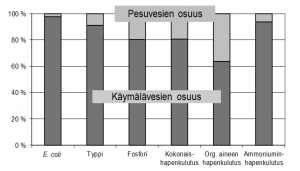
Figure 1: Composition of wastewater generated in households (Särkelä and Lahti, 2013).
In new projects, it is always a good idea to extend separate sewage to the outside of the building, so that combined and separate treatment of toilet and washing water is possible.
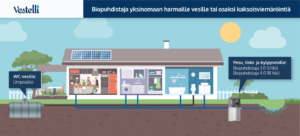
In properties with flush toilets, separate wastewater treatment involves directing the toilet water to an intermediate storage tank, i.e. a closed tank. For the treatment of washing water, a treatment that is considerably simpler and more reliable than the treatment intended for all wastewater is sufficient. Washing water can be treated, for example, with Vestell’s Bio Purifier .
The best benefit from separate treatment is obtained by implementing a waterless or low-water toilet instead of a water toilet. This reduces water consumption, the amount of sludge and the indirect environmental impacts caused by it. At the same time, you save on the costs of emptying the closed tank. With low-water toilet systems, the amount of toilet water can be reduced to less than a tenth compared to a normal water toilet. The products of a completely waterless toilet, with their valuable nutrients, can be used as fertilizer or soil conditioner near their source.
Advantages of separate processing
- The cubic volume and nutrient concentrations of wastewater treated on the property decrease
- Fecal bacteria do not mix with wastewater treated on the property and enter the environment with the discharge water
- The wastewater system is reliable because it is based on simple technical solutions (read: Best user reviews for biopurifier in SYKE’s MunPutsari project )
- Highest cleaning results (see: Cleaning results 2011-2018 )
If you also use a waterless or low-water toilet , the benefits increase even more.
- Utilization of toilet products : Treated toilet products can be used as fertilizer and soil conditioner on the property (read: Utilization of toilet products )
- Economy : water consumption and sludge volume are reduced, emptying costs are reduced (read: Waterless toilet or low-water toilet )
- Environmental friendliness : the tank emptying interval is extended, sludge transport distances are reduced, the load on the water system is reduced